Text vs. Email Marketing: Considerations for Nonprofits
Mike Snusz, Guest Blogger
This guest article was written and submitted by Mike Snusz, Director of Nonprofit Customer Experience at Totango. Please see the end of this article for Mike's bio.
By: Mike Snusz

When it comes to successful nonprofit marketing, you know it’s not just about reaching people, but who you reach and how. For example, an art museum’s audience won’t be the same as a nature center’s audience, and vice versa.
Connecting with the right audience for your organization is crucial to increasing donations and amplifying impact. To do so, you must be strategic about the marketing platforms and channels you use, whether that’s email, text messaging, your website, or social media.
Text and email are tried-and-true ways to communicate with your supporters, each with its own strengths and uses. When it comes to engaging your audience through these channels, how do you know when to use which?
Let’s break down some key text vs. email marketing considerations to inform your strategy.
The Benefits
Your museum can send all sorts of engaging content through both text and email, complete with personalized greetings, eye-catching images, and call-to-action (CTA) links. However, each channel has its key strengths and benefits:
Text Marketing
Text messaging allows your nonprofit to reach its audience no matter where they are, in a more direct, personal, and casual way. Tatango’s text-to-give guide provides several compelling statistics that illustrate the power of text messaging as a marketing channel:
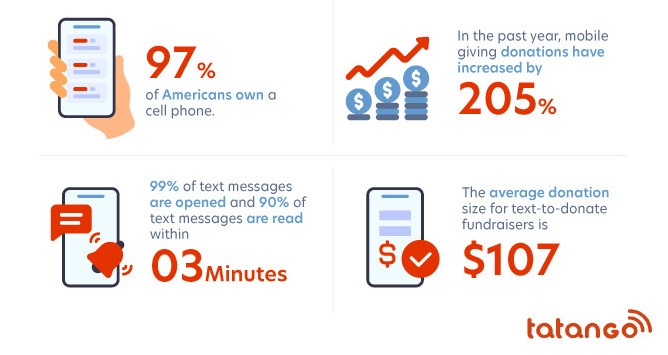
- 97% of Americans own a cellphone.
- In the past year, mobile giving donations have increased by 205%.
- 99% of text messages are opened, and 90% are read within three minutes of sending.
- The average donation size for text-to-donate fundraisers is $107.
Text messaging opens the door for more two-way communication with your audience, turning supporters into engaged participants in your mission. Your team can send surveys to collect feedback and answer questions directly to create more personalized experiences for every supporter.
Email Marketing
According to a Nonprofit Tech for Good report, 68% of nonprofits use email marketing to connect with their audience. Many organizations consider email an essential marketing tool because it:
- Is low-cost.
- Allows for sending more detailed, long-form content.
- Comes with a variety of formatting and design options.
- Makes it easy for recipients to search and reference past communications in their inboxes.
Since emails are typically longer-form content than text messages, your organization can use them to communicate more complex asks or CTAs. For example, let’s say your museum recently held a fundraising gala. To retain the support of your guests and improve your results for next year, you could send a post-event email that thanks each person for attending, shares the impact of their contribution, and invites them to fill out a survey to share their experience.
When and How to Use It
When deciding which marketing channel to use, remember that your audience’s preferences must come first. As NPOInfo’s donor data management guide explains, “It’s important to know who your donors are in order to figure out the best ways to reach them.”
Use what you already know about your supporters to pinpoint the most effective ways you can leverage the following channels. Your current communications can provide a helpful starting point, but if you’re considering a new channel, such as text messaging, continuously analyze your campaigns for maximum insights and impact.
Text Marketing
Remember, it’s not only about the donation requests! Share content that resonates with your audience, rather than only sending texts that ask for donations. Text messaging is especially highly useful for:
Urgent fundraising. For example, if you’re launching a 24-hour fundraising campaign on Giving Tuesday, you can send texts before and during the campaign to create a sense of urgency and encourage people to donate.
Important announcements or reminders. Make supporters aware of upcoming deadlines for membership renewal, event registration, and other relevant initiatives. Send short updates to event registrants and volunteers to keep them in the loop about participation details.
Building authentic supporter relationships. Help supporters feel personally valued by your organization with two-way messaging. Share polls, send exclusive invitations, and invite them to ask questions directly through text.
Not all text marketing platforms are created equal. To make the most of this channel, look for a nonprofit text marketing platform that facilitates sending tailored, automated messages to your audience. Some platforms even come with AI message-composing tools that help you craft more engaging and efficient text messages. You should also be able to track open rates, click-through rates, average donation amounts, and more to monitor your message performance.
Email Marketing
While your museum’s email strategy will depend on its goals, needs, and audience, some of the top uses of email marketing include:
Weekly or monthly newsletters. Emails are an easy way to keep supporters regularly informed about your organization’s mission, activities, and impact without making them feel too overwhelmed by your updates.
Formal appeals. Email comes across as more formal to recipients, which makes it ideal for sending more professional, polished communications to major donors, grantmakers, and corporate partners.
Long-form, detailed content. For example, if a museum is launching new classes or workshops as part of its educational programming, it might send a thorough email explaining its range of offerings and how people can sign up to attend.
Assess your email performance by monitoring open, click-through, unsubscribe, and conversion rates. These metrics will reveal how your audience wants your organization to communicate with them. Use these insights to adjust your design, content, and CTA strategy going forward.
While text and email each have merits and top use cases, adopting a holistic multi-channel marketing strategy ensures that your nonprofit maximizes its reach to current and potential supporters. Cross-promote your nonprofit text messaging campaign through email to build your contact list and encourage your text subscribers to sign up for your email newsletter.
By engaging your audience with a variety of content across various channels, you increase the chances that they stay invested in your organization for years to come.
 About the author - Mike Snusz
Mike Snusz brings 19 years of digital fundraising experience to his role as Director of Nonprofit Customer Experience at Tatango, a text messaging platform for nonprofits and political campaigns. Prior to Tatango, Mike spent 15 years at Blackbaud leading a team of digital consultants that helped nonprofits improve their online fundraising, monthly giving, email marketing and peer-to-peer fundraising programs. Mike started his nonprofit career managing the Ride For Roswell from 2003 to 2005 in his hometown of Buffalo, NY.